

How to design packaging that sells on Amazon & D2C platforms!
August 16, 2025
SEO TIPS
Design Tips
We, as humans, are still kids at heart. When we see something visually attractive, we’re instantly drawn to it. As a co-founder of a premium tea brand myself, I can vouch for this fact - there are no two ways about it.
In retail, you need to take this human trait into consideration, because ultimately, you’re dealing with human minds and their decision-making tendencies.
Think about it - how many times have you walked into a supermarket with a particular brand in mind, only to walk out with another? While the quality of products across brands may be comparable, the truth is undeniable: packaging plays a decisive role, especially when shopping online.
E-commerce packaging - particularly Amazon product packaging isn’t just about making a box look attractive. It’s a strategic marketing tool that identifies, protects, differentiates, and even promotes your brand in a creative way.
Why packaging matters more online?
When a customer walks into a physical store, packaging competes on shelves. But online, the dynamics are different:
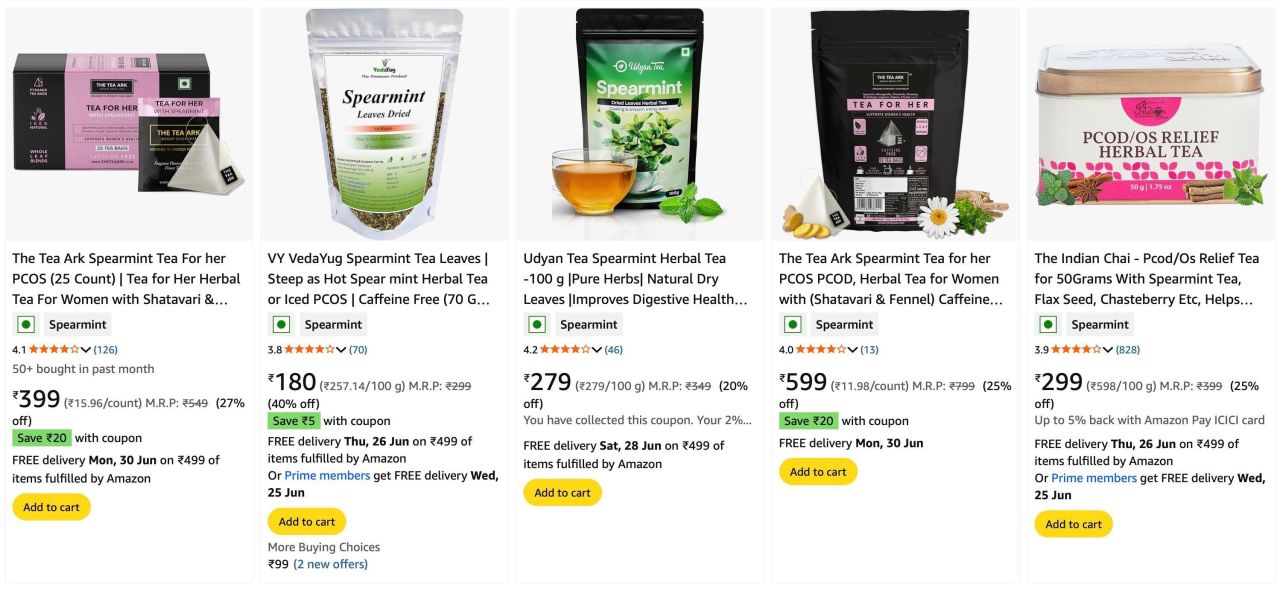
On Amazon, your packaging is mostly seen through product photos and tiny thumbnails. If it doesn’t look appealing in a small digital space, you’ve already lost attention.
On D2C platforms, your packaging is part of the customer journey. A great unboxing experience can generate repeat sales and even free marketing through social media shares.
In short: Packaging is your silent salesman.
5 principles of packaging that sells online.
When customers shop online, they can’t touch, feel, or try your product. The first thing they notice and often the only thing they judge, is your packaging design. Especially on Amazon and D2C platforms, packaging can make the difference between someone clicking “Add to Cart” or scrolling past.
Here, are 5 proven principles we follow at Avyaan Design Lab to design packaging that not only shines but also sells:
1. Clarity is everything
Customers spend just seconds scanning product pages. Your packaging should clearly show:
Product name
Core benefit (what problem it solves)
Key differentiators (organic, cruelty-free, premium, etc.)
Avoid clutter and focus on one or two strong messages that pop, even in small thumbnail images.
2. Optimize for digital platforms
Amazon → Your packaging must look good in thumbnails and search results. Use bold fonts, contrasting colors, and simple icons.
D2C → Lifestyle photography plays a bigger role here. Make sure your packaging is premium, photogenic, and “Instagrammable.” Unboxing experiences matter more than ever.
3. Tell your brand story
Your packaging is the best storytelling canvas. Use:
Colors and fonts that reflect your brand’s personality.
Taglines or short storytelling elements.
Symbols, illustrations, or graphics that highlight your values (eco-friendly, artisanal, luxury).
Customers don’t just buy products - they buy stories.
4. Be practical and user-friendly
Packaging should not only look good, but also be functional:
Sturdy enough for shipping.
Compact (to reduce logistics costs).
Easy to open, reuse, or dispose of.
Eco-friendly options (a growing customer demand).
A thoughtful design makes customers trust your brand more.
5. Build trust through details
Since online buyers can’t physically check your product, trust signals are crucial:
Barcodes, expiry dates, ingredients, or nutritional info.
Legal compliance details.
Certifications (organic, cruelty-free, recyclable, vegan).
These details reassure customers that your product is authentic and safe.
Quick breakdown of one of our packaging projects:
At Avyaan Design Lab, we’ve helped multiple D2C brands craft packaging that doesn’t just shine on the shelf—it sells. Here’s our refined guide, along with a quick breakdown of one of our packaging projects to make it easier to understand.
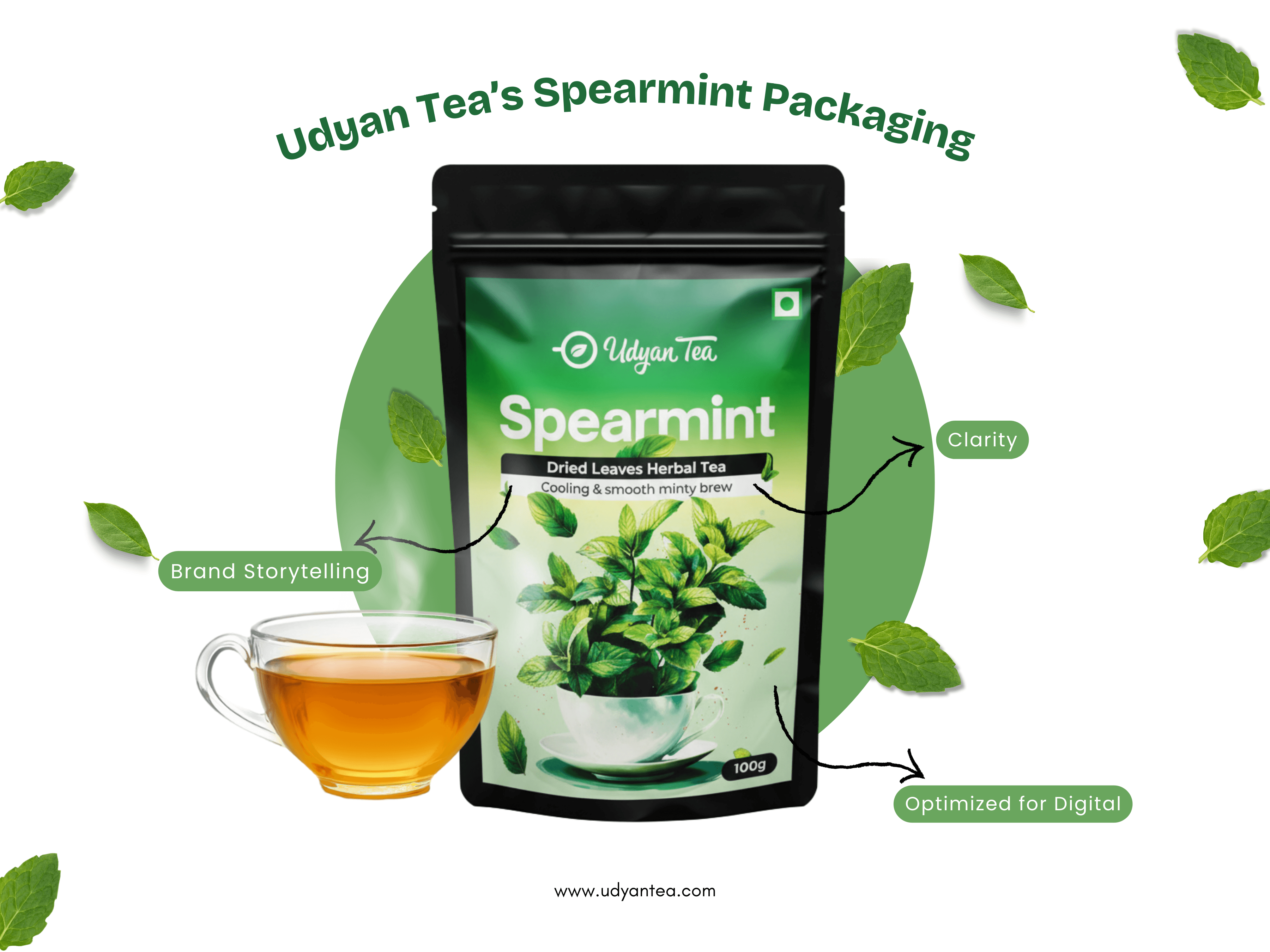
Here’s how Udyan Tea’s spearmint packaging reflects the 5 principles:
Clarity
The front clearly shows:
Product Name: Spearmint in bold, easy-to-read font.
Product Type: Dried Leaves Herbal Tea.
Core Benefit: Cooling & smooth minty brew.
Nothing is cluttered - just sharp, essential messaging that communicates in seconds.Optimized for Digital
Bold green contrast and mint visuals pop on Amazon; tea-cup imagery makes it D2C and Instagram-ready.Brand Storytelling
The green palette and mint leaves symbolize freshness, nature, and health, perfect for a herbal tea.
The tagline highlights the sensory experience: cooling & smooth minty brew.
The design reflects Udyan Tea’s brand promise of authenticity and quality.Practical
Stand-up pouch with resealable zip → keeps tea fresh and user experience smooth.
Compact design → easy to store, ship, and display.
Matte finish → adds a premium feel while still being practical for logistics.Trust
FSSAI mark and standard labeling give credibility.
Weight (100g) mentioned clearly.
Ingredient clarity (Spearmint dried leaves).
All this reassures customers that the product is genuine and safe.
Extra Wow Factor →
The fresh mint imagery and tea cup aren’t just for visual appeal - they’re designed to deliver the “taste experience” even before opening the pack, showing exactly how fresh it feels.
CONCLUSION
As an Amazon seller, remember this: your customer’s journey doesn’t end with clicking “Buy Now.” In fact, that’s where it begins. Packaging is your first opportunity to impress, to delight, and to create a lasting impression.
Wouldn’t you love receiving something wrapped in a beautifully designed box? That’s the power of Amazon product packaging- it can transform a one-time buyer into a loyal customer who keeps coming back.
If you’re an Amazon seller or D2C founder looking to turn first-time buyers into repeat customers through thoughtful, high-impact packaging, Avyaan Design Lab can help.We design packaging that builds trust, elevates your brand, and makes customers want to come back for more.

Enjoyed the read?
Share it with others
Related
insightful reads

How to design packaging that sells on Amazon & D2C platforms!
August 16, 2025
SEO TIPS
Design Tips
We, as humans, are still kids at heart. When we see something visually attractive, we’re instantly drawn to it. As a co-founder of a premium tea brand myself, I can vouch for this fact - there are no two ways about it.
In retail, you need to take this human trait into consideration, because ultimately, you’re dealing with human minds and their decision-making tendencies.
Think about it - how many times have you walked into a supermarket with a particular brand in mind, only to walk out with another? While the quality of products across brands may be comparable, the truth is undeniable: packaging plays a decisive role, especially when shopping online.
E-commerce packaging - particularly Amazon product packaging isn’t just about making a box look attractive. It’s a strategic marketing tool that identifies, protects, differentiates, and even promotes your brand in a creative way.
Why packaging matters more online?
When a customer walks into a physical store, packaging competes on shelves. But online, the dynamics are different:
On Amazon, your packaging is mostly seen through product photos and tiny thumbnails. If it doesn’t look appealing in a small digital space, you’ve already lost attention.
On D2C platforms, your packaging is part of the customer journey. A great unboxing experience can generate repeat sales and even free marketing through social media shares.
In short: Packaging is your silent salesman.
5 principles of packaging that sells online.
When customers shop online, they can’t touch, feel, or try your product. The first thing they notice and often the only thing they judge, is your packaging design. Especially on Amazon and D2C platforms, packaging can make the difference between someone clicking “Add to Cart” or scrolling past.
Here, are 5 proven principles we follow at Avyaan Design Lab to design packaging that not only shines but also sells:
1. Clarity is everything
Customers spend just seconds scanning product pages. Your packaging should clearly show:
Product name
Core benefit (what problem it solves)
Key differentiators (organic, cruelty-free, premium, etc.)
Avoid clutter and focus on one or two strong messages that pop, even in small thumbnail images.
2. Optimize for digital platforms
Amazon → Your packaging must look good in thumbnails and search results. Use bold fonts, contrasting colors, and simple icons.
D2C → Lifestyle photography plays a bigger role here. Make sure your packaging is premium, photogenic, and “Instagrammable.” Unboxing experiences matter more than ever.
3. Tell your brand story
Your packaging is the best storytelling canvas. Use:
Colors and fonts that reflect your brand’s personality.
Taglines or short storytelling elements.
Symbols, illustrations, or graphics that highlight your values (eco-friendly, artisanal, luxury).
Customers don’t just buy products - they buy stories.
4. Be practical and user-friendly
Packaging should not only look good, but also be functional:
Sturdy enough for shipping.
Compact (to reduce logistics costs).
Easy to open, reuse, or dispose of.
Eco-friendly options (a growing customer demand).
A thoughtful design makes customers trust your brand more.
5. Build trust through details
Since online buyers can’t physically check your product, trust signals are crucial:
Barcodes, expiry dates, ingredients, or nutritional info.
Legal compliance details.
Certifications (organic, cruelty-free, recyclable, vegan).
These details reassure customers that your product is authentic and safe.
Quick breakdown of one of our packaging projects:
At Avyaan Design Lab, we’ve helped multiple D2C brands craft packaging that doesn’t just shine on the shelf—it sells. Here’s our refined guide, along with a quick breakdown of one of our packaging projects to make it easier to understand.
Here’s how Udyan Tea’s spearmint packaging reflects the 5 principles:
Clarity
The front clearly shows:
Product Name: Spearmint in bold, easy-to-read font.
Product Type: Dried Leaves Herbal Tea.
Core Benefit: Cooling & smooth minty brew.
Nothing is cluttered - just sharp, essential messaging that communicates in seconds.Optimized for Digital
Bold green contrast and mint visuals pop on Amazon; tea-cup imagery makes it D2C and Instagram-ready.Brand Storytelling
The green palette and mint leaves symbolize freshness, nature, and health, perfect for a herbal tea.
The tagline highlights the sensory experience: cooling & smooth minty brew.
The design reflects Udyan Tea’s brand promise of authenticity and quality.Practical
Stand-up pouch with resealable zip → keeps tea fresh and user experience smooth.
Compact design → easy to store, ship, and display.
Matte finish → adds a premium feel while still being practical for logistics.Trust
FSSAI mark and standard labeling give credibility.
Weight (100g) mentioned clearly.
Ingredient clarity (Spearmint dried leaves).
All this reassures customers that the product is genuine and safe.
Extra Wow Factor →
The fresh mint imagery and tea cup aren’t just for visual appeal - they’re designed to deliver the “taste experience” even before opening the pack, showing exactly how fresh it feels.
CONCLUSION
As an Amazon seller, remember this: your customer’s journey doesn’t end with clicking “Buy Now.” In fact, that’s where it begins. Packaging is your first opportunity to impress, to delight, and to create a lasting impression.
Wouldn’t you love receiving something wrapped in a beautifully designed box? That’s the power of Amazon product packaging- it can transform a one-time buyer into a loyal customer who keeps coming back.
If you’re an Amazon seller or D2C founder looking to turn first-time buyers into repeat customers through thoughtful, high-impact packaging, Avyaan Design Lab can help.We design packaging that builds trust, elevates your brand, and makes customers want to come back for more.

Enjoyed the read?
Share it with others
Related
insightful reads
How to design packaging that sells on Amazon & D2C platforms!
August 16, 2025
SEO TIPS
Design Tips
We, as humans, are still kids at heart. When we see something visually attractive, we’re instantly drawn to it. As a co-founder of a premium tea brand myself, I can vouch for this fact - there are no two ways about it.
In retail, you need to take this human trait into consideration, because ultimately, you’re dealing with human minds and their decision-making tendencies.
Think about it - how many times have you walked into a supermarket with a particular brand in mind, only to walk out with another? While the quality of products across brands may be comparable, the truth is undeniable: packaging plays a decisive role, especially when shopping online.
E-commerce packaging - particularly Amazon product packaging isn’t just about making a box look attractive. It’s a strategic marketing tool that identifies, protects, differentiates, and even promotes your brand in a creative way.
Why packaging matters more online?
When a customer walks into a physical store, packaging competes on shelves. But online, the dynamics are different:
On Amazon, your packaging is mostly seen through product photos and tiny thumbnails. If it doesn’t look appealing in a small digital space, you’ve already lost attention.
On D2C platforms, your packaging is part of the customer journey. A great unboxing experience can generate repeat sales and even free marketing through social media shares.
In short: Packaging is your silent salesman.
5 principles of packaging that sells online.
When customers shop online, they can’t touch, feel, or try your product. The first thing they notice and often the only thing they judge, is your packaging design. Especially on Amazon and D2C platforms, packaging can make the difference between someone clicking “Add to Cart” or scrolling past.
Here, are 5 proven principles we follow at Avyaan Design Lab to design packaging that not only shines but also sells:
1. Clarity is everything
Customers spend just seconds scanning product pages. Your packaging should clearly show:
Product name
Core benefit (what problem it solves)
Key differentiators (organic, cruelty-free, premium, etc.)
Avoid clutter and focus on one or two strong messages that pop, even in small thumbnail images.
2. Optimize for digital platforms
Amazon → Your packaging must look good in thumbnails and search results. Use bold fonts, contrasting colors, and simple icons.
D2C → Lifestyle photography plays a bigger role here. Make sure your packaging is premium, photogenic, and “Instagrammable.” Unboxing experiences matter more than ever.
3. Tell your brand story
Your packaging is the best storytelling canvas. Use:
Colors and fonts that reflect your brand’s personality.
Taglines or short storytelling elements.
Symbols, illustrations, or graphics that highlight your values (eco-friendly, artisanal, luxury).
Customers don’t just buy products - they buy stories.
4. Be practical and user-friendly
Packaging should not only look good, but also be functional:
Sturdy enough for shipping.
Compact (to reduce logistics costs).
Easy to open, reuse, or dispose of.
Eco-friendly options (a growing customer demand).
A thoughtful design makes customers trust your brand more.
5. Build trust through details
Since online buyers can’t physically check your product, trust signals are crucial:
Barcodes, expiry dates, ingredients, or nutritional info.
Legal compliance details.
Certifications (organic, cruelty-free, recyclable, vegan).
These details reassure customers that your product is authentic and safe.
Quick breakdown of one of our packaging projects:
At Avyaan Design Lab, we’ve helped multiple D2C brands craft packaging that doesn’t just shine on the shelf—it sells. Here’s our refined guide, along with a quick breakdown of one of our packaging projects to make it easier to understand.
Here’s how Udyan Tea’s spearmint packaging reflects the 5 principles:
Clarity
The front clearly shows:
Product Name: Spearmint in bold, easy-to-read font.
Product Type: Dried Leaves Herbal Tea.
Core Benefit: Cooling & smooth minty brew.
Nothing is cluttered - just sharp, essential messaging that communicates in seconds.Optimized for Digital
Bold green contrast and mint visuals pop on Amazon; tea-cup imagery makes it D2C and Instagram-ready.Brand Storytelling
The green palette and mint leaves symbolize freshness, nature, and health, perfect for a herbal tea.
The tagline highlights the sensory experience: cooling & smooth minty brew.
The design reflects Udyan Tea’s brand promise of authenticity and quality.Practical
Stand-up pouch with resealable zip → keeps tea fresh and user experience smooth.
Compact design → easy to store, ship, and display.
Matte finish → adds a premium feel while still being practical for logistics.Trust
FSSAI mark and standard labeling give credibility.
Weight (100g) mentioned clearly.
Ingredient clarity (Spearmint dried leaves).
All this reassures customers that the product is genuine and safe.
Extra Wow Factor →
The fresh mint imagery and tea cup aren’t just for visual appeal - they’re designed to deliver the “taste experience” even before opening the pack, showing exactly how fresh it feels.
CONCLUSION
As an Amazon seller, remember this: your customer’s journey doesn’t end with clicking “Buy Now.” In fact, that’s where it begins. Packaging is your first opportunity to impress, to delight, and to create a lasting impression.
Wouldn’t you love receiving something wrapped in a beautifully designed box? That’s the power of Amazon product packaging- it can transform a one-time buyer into a loyal customer who keeps coming back.
If you’re an Amazon seller or D2C founder looking to turn first-time buyers into repeat customers through thoughtful, high-impact packaging, Avyaan Design Lab can help.We design packaging that builds trust, elevates your brand, and makes customers want to come back for more.
Enjoyed the read?
Share it with others
Related
insightful reads
feeling lucky yet?
feeling lucky yet?
let’s get started with your brand’s transformative journey
let’s get started with your brand’s transformative journey
menu
we’re everywhere!
we’re everywhere!
we’re everywhere!


everywhere!
@avyaandesignlab
everywhere!
@avyaandesignlab
everywhere!
@avyaandesignlab
everywhere!
@avyaandesignlab
let's enjoy some music,
shall we?

The Four Seasons
Antonio Vivaldi
The Four Seasons
Antonio Vivaldi